Back to blog
June 1, 2025Ants

Carpenter Ants in Ontario: Signs, Damage, and How to Get Rid of Them

Carpenter ants in Ontario? Spot the signs, the damage they cause, how to tell them from termites, and how Sterex treats them across the GTA. Call 289-210-7378.

By Jitu Patel

Carpenter Ants in Ontario: Signs, Damage, and How to Get Rid of Them

You notice a small pile of what looks like coarse sawdust near your baseboard. You didn't drop anything there, and it keeps coming back even after you sweep it up. A few days later you hear a faint rustling inside the wall. That combination almost always points to one thing in an Ontario home: carpenter ants.

Carpenter ants are large, mostly black ants that excavate wood to build their nests. They don't eat the wood like termites do, but the tunnels they carve out can weaken your home's structure over time if the colony is left alone. In the GTA they're one of the most common structural pests we deal with, and they're easy to underestimate until the damage adds up.

This guide covers what carpenter ants are, why they keep showing up in Ontario homes, how to tell them apart from termites, and how a professional carpenter ant treatment actually works.

What Carpenter Ants Look Like

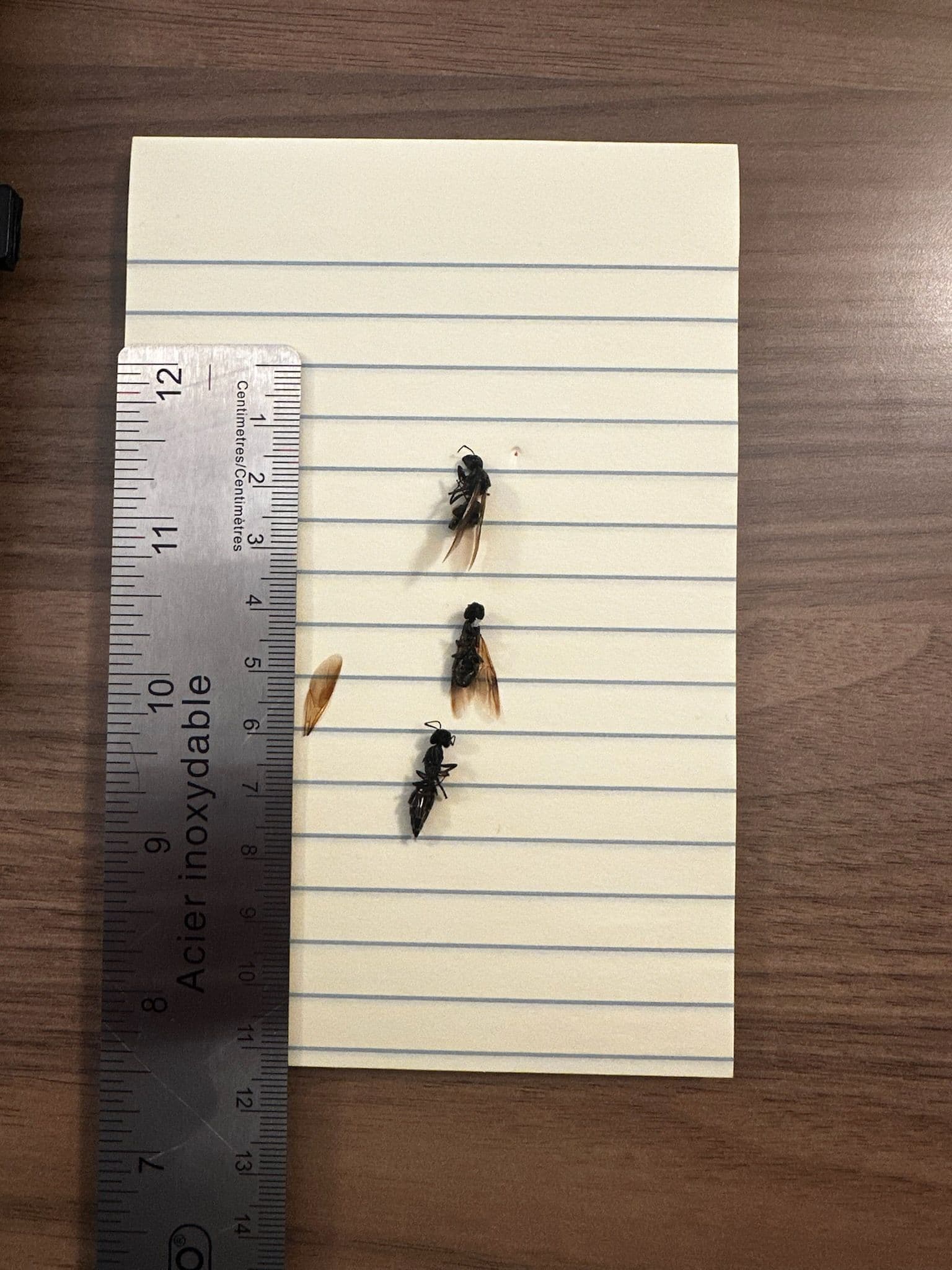
The species you'll almost always find in the GTA is the black carpenter ant (Camponotus pennsylvanicus). They're big compared to most household ants. Workers range from about 6 to 12 mm, and a queen can reach close to 19 mm. The body is black or blackish red with a single pinched node at the waist, giving them that classic hourglass shape.

One thing that throws people off is that not all the ants in a colony are the same size. Carpenter ants are polymorphic, which means a single colony produces both small (minor) and large (major) workers. So if you're seeing black ants of noticeably different sizes coming from the same area, that's a strong carpenter ant tell.

How Carpenter Ant Colonies Work

A carpenter ant colony starts with a single mated queen who finds a small cavity in moist wood and begins laying eggs. The colony grows slowly. It usually takes three to six years for a colony to mature, and a mature nest can hold 2,000 or more workers. The largest colonies can climb past 50,000 individuals once you count brood and reproductives.

Here's the part that makes them tricky to deal with. Once a parent colony gets large enough, it sets up satellite colonies. These are offshoot nests connected to the main colony, often tucked into wall voids, attics, hollow doors, or insulation inside your home. The main nest might actually be in a tree or stump outside, while the satellite is living in your kitchen wall. That's why spraying a few ants you see on the counter does almost nothing. You're treating the symptom, not the nest.

When a colony has been established for a few years, it starts producing winged reproductives called swarmers, or alates. In Ontario these naturally swarm outdoors in the warmer months, roughly June through August, to mate and start new colonies.

Why Carpenter Ants Are So Common in the GTA

Ontario is close to ideal habitat for these ants. Our climate runs cold winters into warm, humid summers, and carpenter ants do well in that cycle. They overwinter in a dormant state and come roaring back once it warms up.

The GTA also has a lot of mature hardwood trees, which are a natural home base for parent colonies, plus a lot of older housing stock built with wood framing. Add in the moisture problems that come with Ontario freeze and thaw cycles (leaky window frames, damp basements, rotting fascia and deck boards) and you've got exactly what carpenter ants look for. They're drawn to soft, moist, or decayed wood first because it's easy to tunnel through.

How They Get Into Your Home

Carpenter ants are foragers and they'll travel surprising distances. The most common entry routes we see in GTA homes are:

  • Tree branches and shrubs touching the roofline, soffit, or siding, which act as a direct bridge
  • Firewood stacked against the house or in the garage
  • Window and door frames with moisture damage
  • Gaps around plumbing lines entering through floors or exterior walls
  • Cracks in the foundation and gaps at window wells
  • Wood-to-soil contact on decks, porches, and exterior trim

Once they find a moist void inside, a satellite colony can settle in and you may never see the main nest at all.

Signs of Carpenter Ants

A few signs are worth knowing so you can catch this early:

  • Frass. This is the big one. Carpenter ants push coarse, sawdust-like debris out of their galleries. It looks like rough pencil shavings and usually has bits of dead insects mixed in. It is not a fine powder.
  • Sound. A faint rustling or crunching inside walls when the house is quiet is the colony chewing and moving.
  • Swarmers indoors. Large winged ants showing up inside your home, especially in early spring, almost always mean a colony is nesting inside. Indoor warmth wakes them up earlier than the outdoor population, so seeing them inside before the weather is warm is a red flag.
  • Trails at night. Carpenter ants forage heavily after dark. A steady trail along a foundation, fence, or counter at night points to an active nest nearby.
  • Hollow-sounding wood. Structural wood that sounds hollow when you tap it can mean galleries underneath.

The Damage Carpenter Ants Cause

Carpenter ants don't eat wood. They excavate it to make room for the colony, hollowing out smooth galleries as they go. They start in soft, moist, or decayed wood, but a growing colony will expand into sound structural wood over time.

The damage is slow, but it compounds. The wet wood invites the ants, the ants hollow it out further, and the weakened wood holds even more moisture. Left long enough, that can mean compromised joists, wall studs, and other load-bearing members. This is why catching a carpenter ant problem early matters so much more than people expect.

Carpenter Ants vs. Termites: How to Tell the Difference

A lot of GTA homeowners panic and assume termites. The two are easy to tell apart once you know what to look for.

Carpenter ants have elbowed (bent) antennae, a clearly pinched waist, and they leave coarse frass with insect parts in it. Termites have straight, beaded antennae, a thick straight waist with no pinch, and a creamy white to translucent body. Termite damage looks different too. Subterranean termites (the kind found in parts of southern Ontario) leave mud tubes and fine, muddy debris rather than the dry, sawdust-like frass carpenter ants kick out. If you're finding clean piles of coarse shavings, you're almost certainly dealing with carpenter ants.

When Carpenter Ants Are Most Active in Ontario

Activity ramps up in spring as colonies wake from overwintering. If a colony is living inside your heated home, the warmth can trigger swarmers to emerge indoors as early as March, which is one of the clearest signs of an interior nest. Outdoors, natural swarming runs through the summer, roughly June to August. Summer is also peak foraging season, so that's when most people first notice trails and frass.

How a Professional Carpenter Ant Treatment Works

Here's how we actually treat carpenter ants at Sterex. The goal is never just to kill the ants you can see. It's to reach the colony and break it.

Finding the colony first

Before any product goes down, we locate the colony area by following frass, ant trails, and sound. The nest is often in cabinets, corners near moisture, or along plumbing lines. Everything works outward from there, because treating the right spot is what makes the difference.

Interior treatment

Our primary interior product is Seclira, a flonicamid-based concentrate that carpenter ants are highly sensitive to. It has a strong residual effect, so ants that walk through a treated area carry it back to the colony and pass it along. That's exactly what you want with a pest that nests out of sight.

We apply it along all the baseboards in and around the colony area, into cracks and crevices, inside cabinets, behind appliances, around plumbing penetrations, and into any hollow or void areas where the colony may be set up. We also apply dust into hidden spaces like wall voids, behind outlets, and at ceiling and floor junctions, because that's where liquid spray can't reach but the ants still travel.

Exterior treatment

Outside, we use Dragnet, a permethrin-based residual spray, to band the foundation and perimeter. We don't rush this part. The foundation gets a thorough treatment into cracks, gaps around utilities, weep holes, window wells, and the base of the home. The point is a solid residual barrier that stops foragers from getting back in and keeps satellite colonies from re-establishing.

What to prep before the visit

A little prep helps the technician reach the colony:

  • Clear under sinks and inside kitchen and bathroom cabinets, plus any spots with known ant activity
  • Pull appliances slightly away from the walls where you can
  • Move anything stored against the exterior foundation, like firewood and garden bags

How to Prevent Carpenter Ants

Treatment handles the colony you have. Prevention keeps the next one out. The theme with carpenter ants is moisture and access, so most of this comes down to taking those away.

  • Fix moisture problems first. This is the single most important step. Carpenter ants are drawn to soft, moist, or decayed wood, so fix leaks under sinks, around windows, and in basements, and deal with any wood-to-soil contact outside.
  • Seal gaps and cracks. Caulk gaps where baseboards meet flooring, around window and door frames, and any foundation cracks. Use expanding foam for larger voids and paintable caulk for visible trim. This removes both entry points and nesting sites.
  • Manage firewood and wood debris. Don't store firewood against the house or in the garage. Keep it elevated and well away from the foundation.
  • Trim trees and shrubs. Any branch or shrub touching the roofline, soffit, or siding is an ant highway. Keep at least a two-foot gap.
  • Repair wood damage promptly. Rotting fascia, window sills, and deck boards are an open invitation. The longer the decay sits, the more likely ants find it.
  • Seal around plumbing penetrations. Plumbing lines entering through floors or exterior walls are a common entry point. Seal them with spray foam or silicone caulk.

Frequently Asked Questions

Are carpenter ants dangerous to my home?

They can be. Carpenter ants don't eat wood, but they hollow it out to nest, and an established colony can expand from damp wood into sound structural members over time. The damage is slow but cumulative, so a colony left alone for a few years can weaken joists and studs. They're not a threat to your health, but they are a threat to your home.

How do I know if I have carpenter ants or termites?

Look at the antennae, waist, and debris. Carpenter ants have bent antennae, a pinched waist, and leave coarse, sawdust-like frass with insect parts in it. Termites have straight antennae, a thick straight waist, and a pale, translucent body, and they leave mud tubes or fine muddy debris instead of dry shavings. Coarse piles of shavings almost always mean carpenter ants.

Can I get rid of carpenter ants myself?

You can knock down the ants you see, but DIY rarely solves the actual problem. The nest is usually hidden in a wall void, cabinet, or satellite colony you can't reach, and surface sprays don't get to it. Professional treatment works because it targets the colony with a product the ants carry back to the nest, plus an exterior barrier to stop re-entry.

When are carpenter ants most active in Ontario?

They become active in spring as colonies wake up, and summer is peak foraging season. If you see winged swarmers inside your home in early spring, that usually means a colony is nesting indoors, since interior warmth wakes them earlier than the outdoor population. Outdoor swarming typically runs from June through August.

How long does a professional carpenter ant treatment take?

A standard residential treatment is usually completed in a single visit, covering both the interior colony area and a full exterior perimeter. The ants don't all disappear instantly, though. Because the product is carried back to the nest, you'll typically see activity drop off over the days following the visit as it works through the colony.

Do carpenter ants come back after treatment?

They can if the conditions that attracted them are still there. The residual barrier we apply prevents re-entry and satellite colonies from re-establishing, but long-term prevention depends on fixing moisture issues, sealing entry points, and keeping wood and branches away from the house. Treatment plus prevention is what keeps them gone.

Dealing With Carpenter Ants in the GTA?

If you're finding frass, hearing sounds in the walls, or seeing big black ants around the house, don't wait for the damage to add up. Sterex Pest Control handles carpenter ants across the GTA, including Brampton, Mississauga, Vaughan, Markham, Toronto, and the surrounding area. Call us at 289-210-7378 or visit sterex.ca to book a treatment.

Share this article:

Common pest questions

These are the questions we use to decide whether a problem is safe to monitor, worth preventing, or ready for professional service.

When is DIY not enough?

When activity keeps returning, pests are visible during the day, there are bites or droppings, or entry points are still open.

What should I do before service?

Do not spray over active areas with store products. Take photos, note where activity is happening, and keep access clear where possible.

Do you handle prevention too?

Yes. Sterex handles pest treatment, rodent prevention, wildlife exclusion, sealing, and seasonal protection plans.

Where do you work?

We service Toronto, Brampton, Mississauga, Vaughan, Markham, Scarborough, Etobicoke, North York, and nearby GTA areas.

Get seasonal GTA pest alerts

Short, useful emails about what is active right now, what to check around your property, and when it is worth calling a technician.

No spam. Just prevention tips and seasonal pest activity updates.